Delay in C: delay function is used to suspend execution of a program for a particular time.
Declaration: void delay(unsigned int);
Here unsigned int is the number of milliseconds (remember 1 second = 1000 milliseconds). To use delay function in your program you should include the 'dos.h' header file which is not a part of standard C library.
Citing from the Dev-C help: 'Compile delay This option is present to provide a delay before compiling. Normally, you will not use this. If make complains of the timestamp being invalid, try specifying a delay. Delay in C: delay function is used to suspend execution of a program for a particular time. How to use delay function in C or C language in hindi by programming desire.You can create any animation using delay function. Void delay (int time). // this function will create a pause in the runtime process for the number of milliseconds that is given in 'time'. Long pause; clockt time1,time2; // datatype variablename. Pause = time; // if you want to be more accurate replace time with ' time. (CLOCKSPERSEC/1000); ' // i.e. Dev-C is a free full-featured integrated development environment (IDE) distributed under the GNU General Public License for programming in C and C.It was originally developed by Colin Laplace and first released in 1998. It is written in Delphi. It is bundled with, and uses, the MinGW or TDM-GCC 64bit port of the GCC as its compiler.Dev-C can also be used in combination with Cygwin. Dos.h delay function in C: Here, we will learn about the delay function of dos.h header file in C through a simple example/program.

Delay in C program
If you don't wish to use delay function then you can use loops to produce delay in a C program.
#include<stdio.h>int main()
{
int c, d;
for(c =1; c <=32767; c++)
for(d =1; d <=32767; d++)
{}
return0;
}
We have not written any statement in the loop body. You may write some statements that doesn't affect logic of the program.
C programming code for delay
#include<stdio.h>#include<stdlib.h>
main()
{
printf('This C program will exit in 10 seconds.n');
delay(10000);

return0;
}
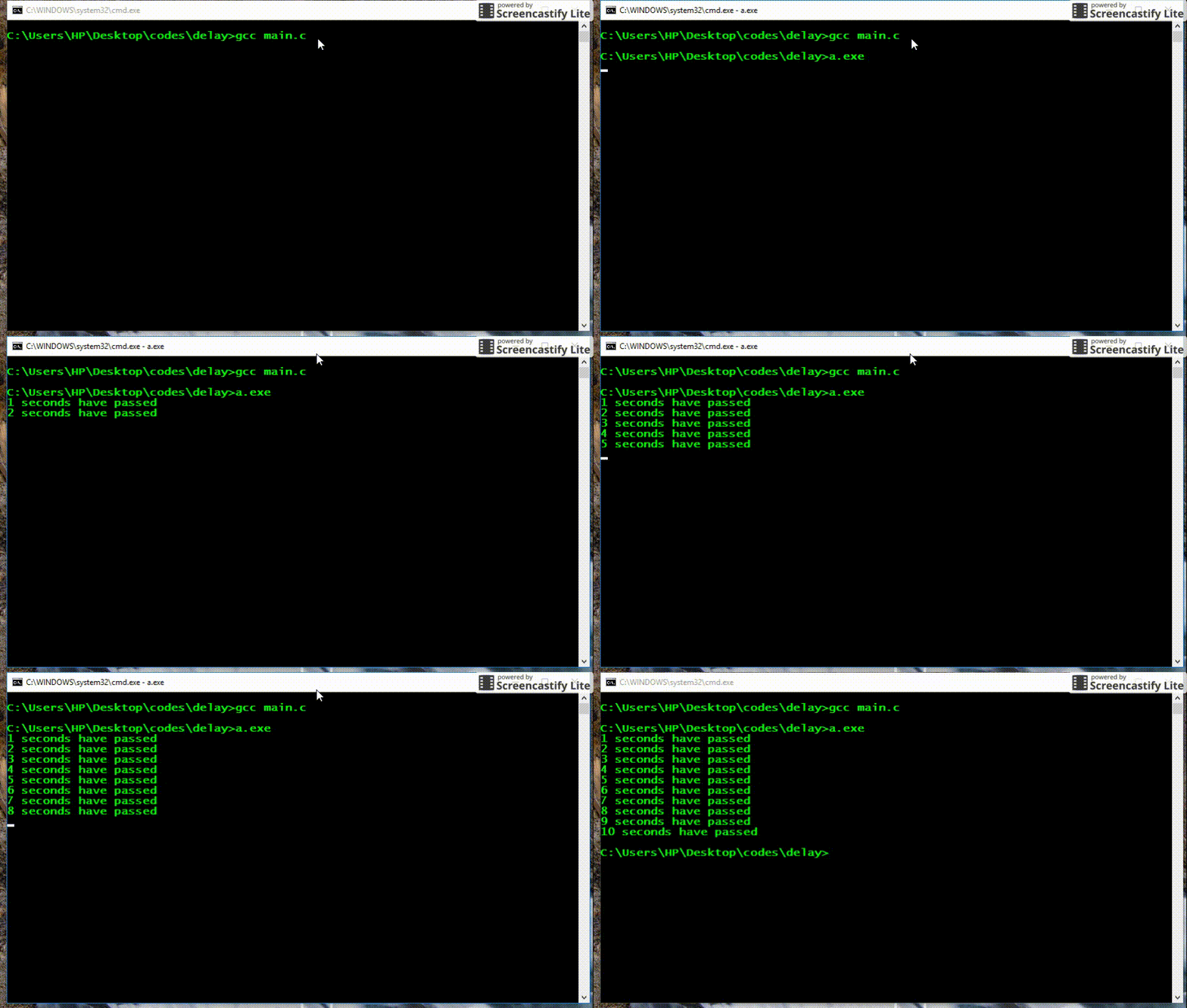
This C program exits in ten seconds, after the printf function is executed the program waits for 10000 milliseconds or 10 seconds and then it terminates.
2b 2b Apartments
Dev-C++ showing its updated UI and new variable browsing options | |
| Developer(s) | Bloodshed Software (Colin Laplace) until 2005, Orwell (Johan Mes) from 2011 to 2020, Embarcadero since 2020 |
|---|---|
| Stable release | |
| Repository | |
| Written in | Delphi |
| Operating system | Microsoft Windows, Linux (alpha only) |
| Type | Integrated development environment |
| License | GNU General Public License |
| Website | www.embarcadero.com/free-tools/dev-cpp orwelldevcpp.blogspot.com www.bloodshed.net |
2b 2b Floor Plan
Dev-C++ is a free full-featured integrated development environment (IDE) distributed under the GNU General Public License for programming in C and C++. It was originally developed by Colin Laplace and first released in 1998. It is written in Delphi.
It is bundled with, and uses, the MinGW or TDM-GCC 64bit port of the GCC as its compiler. Dev-C++ can also be used in combination with Cygwin or any other GCC-based compiler.[1]
DevPaks[edit]
An additional aspect of Dev-C++ is its use of DevPaks: packaged extensions on the programming environment with additional libraries, templates, and utilities. DevPaks often contain, but are not limited to, GUI utilities, including popular toolkits such as GTK+, wxWidgets, and FLTK. Other DevPaks include libraries for more advanced function use. Users of Dev-C++ can download additional libraries, or packages of code that increase the scope and functionality of Dev-C++, such as graphics, compression, animation, sound support and many more. Users can create DevPaks and host them for free on the site. Also, they are not limited to use with Dev-C++ - the site says 'A typical devpak will work with any MinGW distribution (with any IDE for MinGW)'.
Development status[edit]
From February 22, 2005 the project was not noticeably active, with no news posted nor any updated versions released. In a 2006 forum post, lead developer Colin Laplace stated that he was busy with real-life issues and did not have time to continue development of Dev-C++.[2] In a 2020 forum post, Orwell lead developer Johan Mes stated that he 'will probably still not have any time to work on this project'.[3]
There are three forks of Dev-C++ since then: wxDev-C++, the Orwell version, and the Embarcadero-maintained fork version.
wxDev-C++ version[edit]
wxDev-C++ is a development team that has taken Dev-C++ and added new features such as support for multiple compilers and a RAD designer for wxWidgets applications.[4]
Delay Function In Dev C 2b 2b Code
Orwell version[edit]
On June 30, 2011 an unofficial version 4.9.9.3 of Dev-C++ was released by Orwell (Johan Mes), an independent programmer,[5] featuring the more recent GCC 4.5.2 compiler, Windows' SDK resources (Win32 and D3D), numerous bugfixes, and improved stability. On August 27, after five years of officially being in a beta stage, version 5.0 was released.[6] This version also has its own separate SourceForge[7] page since version 5.0.0.5, because the old developer isn't responding to combining requests. In July 2014, Orwell Dev-C++ 5.7.1 was released featuring the then recent GCC 4.8.1 which supports C++11.

Embarcadero version[edit]
On July 1, 2020 a new fork version 5.50 of Dev-C++ was sponsored and released by Embarcadero featuring a code upgrade to Delphi 10.4. On October 12, 2020 a new fork version 6.0 of Dev-C++ was sponsored and released by Embarcadero with a more recent GCC 9.2.0 compiler with C++11 and partial C++20 support, new high DPI support, UTF8 file support, upgraded icons, dark theme, and additional changes.[8]
Notable uses[edit]
On May 4, 2015, The Singapore Prime Minister Lee Hsien Loong posted his Sudoku solver program in C++ on Facebook. In his screen shot, he's using Microsoft Windows and Dev-C++ as his IDE.[9]
It is often recommended for beginners learning C or C++,[10][11][12][13][14][15] and is available on Wine.[16] It is compared with Turbo C++[17] or other IDEs.[18]
See also[edit]
References[edit]
- ^'Bloodshed Software - Providing Free Software to the internet community'. bloodshed.net. Retrieved 8 September 2015.
- ^'Dev-C++'. sourceforge.net. Retrieved 8 September 2015.
- ^'Orwell Dev-C++'. sourceforge.net. Retrieved 14 July 2020.
- ^[http://wxdsgn.sourceforge.net/?q=node/19
- ^Orwell. 'Dev-C++ Blog'. orwelldevcpp.blogspot.com. Retrieved 8 September 2015.
- ^Orwell. 'Dev-C++ Blog'. orwelldevcpp.blogspot.com. Retrieved 8 September 2015.
- ^orwelldevcpp. 'Dev-C++'. SourceForge. Retrieved 8 September 2015.
- ^Embarcadero. 'Embarcadero Dev-C++'. GitHub. Retrieved 12 October 2020.
- ^'Prime Minister of Singapore shares his C++ code for Sudoku solver'. Ars Technica. Retrieved 8 September 2015.
- ^https://www.evl.uic.edu/aspale/dvl/dev-cpp/
- ^https://chortle.ccsu.edu/bloodshed/howtogl.html
- ^http://www.brooklyn.cuny.edu/web/aca_naturalsciences_cis/STARTDev.pdf
- ^https://en.wikibooks.org/wiki/Programming_Fundamentals/Integrated_Development_Environment/Dev-C%2B%2B
- ^https://ece.uwaterloo.ca/~dwharder/aads/Tutorial/devcpp.html
- ^https://www.instructables.com/Your-First-Program-in-C-1/
- ^https://appdb.winehq.org/objectManager.php?sClass=version&iId=5960
- ^https://www.geeksforgeeks.org/difference-between-turbo-c-and-dev-c/
- ^https://www.reddit.com/r/cpp_questions/comments/5o7w29/pros_and_cons_dev_c_vs_codeblocks_vs_others/
External links[edit]
- Official website
- Dev-C++ on SourceForge.net
- Orwell Dev-C++ on SourceForge.net