NPR’s sites use cookies, similar tracking and storage technologies, and information about the device you use to access our sites (together, “cookies”) to enhance your viewing, listening and user experience, personalize content, personalize messages from NPR’s sponsors, provide social media features, and analyze NPR’s traffic. This information is shared with social media, sponsorship, analytics, and other vendors or service providers. See details.

You may click on “Your Choices” below to learn about and use cookie management tools to limit use of cookies when you visit NPR’s sites. You can adjust your cookie choices in those tools at any time. If you click “Agree and Continue” below, you acknowledge that your cookie choices in those tools will be respected and that you otherwise agree to the use of cookies on NPR’s sites.
Moonlight Sonata is a 1937 British drama film directed by Lothar Mendes and written by E. Delafield and Edward Knoblock. The film stars Ignacy Jan Paderewski, Charles Farrell, Marie Tempest, Barbara Greene and Eric Portman. The film was released on 11 February 1937, by United Artists and re-released in 1943 as The Charmer (shortened).
- 'Moonlight Sonata: Deafness in Three Movements' is a documentary film by Irene Taylor Brodsky, airing on HBO December 2019.
- Aug 12, 2020 Download and print in PDF or MIDI free sheet music for Moonlight Sonata by Ludwig van Beethoven arranged by BNTT-Piano for Piano (Solo).
Best 5 Beethoven Books on Amazon
1.Beethoven: The Universal Composer by Edmund Morris
2.Beethoven by Maynard Solomon
3.Beethoven: The Music and the Life by Lewis Lockwood
4.Late Beethoven: Music, Thought, Imagination by Maynard Solomon
5.Beethoven as I Knew Him by Anton Felix Schindler
Beethoven's Moonlight Sonata
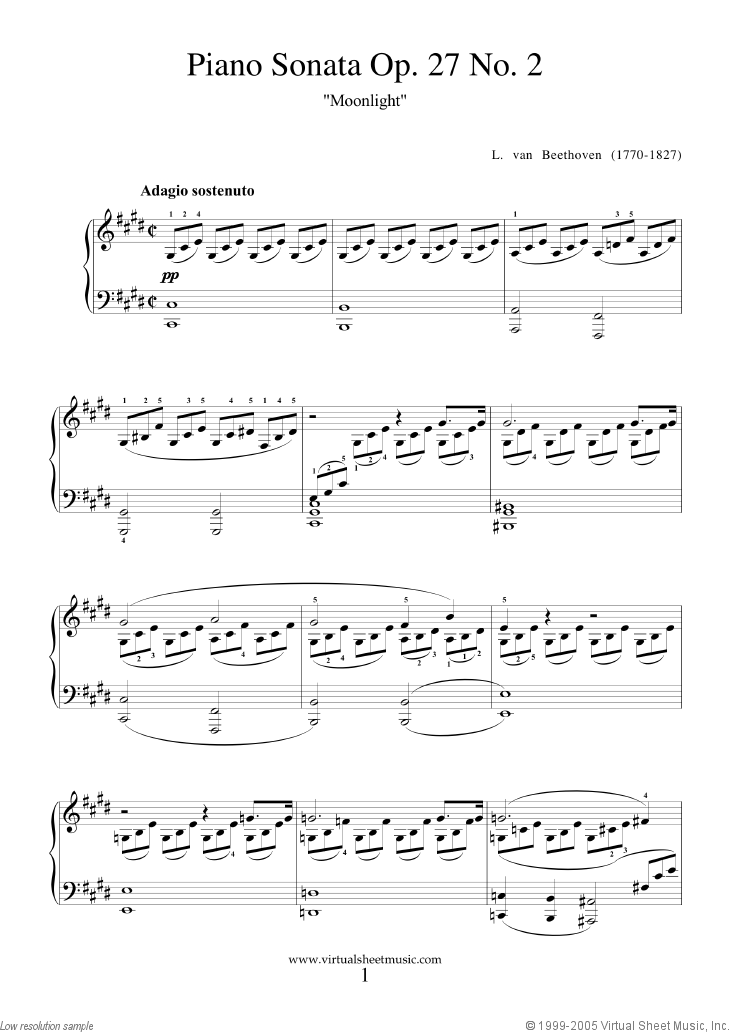
The Moonlight Sonata was composed in the summer of 1801 in Hungary, on an estate belonging to the Brunswick family. The composition was published in 1802 and was dedicated to Beethoven’s pupil and passion, 17 years old Countess Giulietta Gucciardi.
The Sonata is one of the most popular piano sonatas from Beethoven’s creation. It is also named The Moonlight Sonata by poet Ludwig Rellstab who, in 1832, had this inspiration on a moon lit night on the banks of the Lucerna River. Some biographers make the connection between the unshared love the composer held for Giulietta Guicciardi and the sonorities of the first part. Even more so, this sonata was dedicated to Giulietta, the musical theme of the first part being borrowed from a German ballad as Wyzewa observed.
According to Fischer, this image has no connection with Beethoven’s intentions. He rather attributes this atmosphere to the feeling that overwhelmed the composer when he took watch at the side of a friend who prematurely left the world of the living. In one of Beethoven’s manuscripts there are several notes from Mozart’s Don Juan, notes that follow the killing of the Commander by Don Juan, and lower, this passage is rendered in C sharp minor in absolute resemblance to the first part of the sonata in C sharp minor. Analyzing and comparing, one could realize that it cannot be the case of a romantic moon lit night, but rather of a solemn funeral hymn.
Moonlight Sonata Valentina
The piano sonata has three parts

I. Adagio Sostenuto
II. Allegretto

III. Presto Agitato
The parts of the sonata give the impression of a whole first of all through the elaboration of themes and motifs. Consequently, the main musical theme of the first part becomes very elaborate in the second part, and the second motif of the main theme will be encountered in the first theme of part III.
Part I – Adagio Sostenuto - is based on an accompanying motif in triplet rhythm that, together with a accented notes motif, creates the impression of a grave, meditative state of mind. The composer adds the following direction at the beginning of the first part: 'Si deve suonare tutto pezzo delicatissimamente e senza sordino' which means that the performer should play the part with great delicacy and without dampers. It is also true that the modern piano has a much longer sustain time than the instruments of Beethoven's day. Therefore, his instruction cannot be followed by pianists playing modern instruments without creating an unpleasantly dissonant sound. (Wikipedia, The Moonlight Sonata Page)
The second part - Allegretto - is very small in size which leads to the idea that it was conceived more as a connection between the first and third part, rather than a part all by itself. The feeling is now denser in consistency, and the fairly meditative character of the first part gradually fades away, preparing the tumult of the third part.
The third part – Presto Agitato - is twice as long as the first two parts. Fischer felt this part as being the representation of a storm. A very impetuous storm, if we take into account the fact that at the time when he was composing the sonata, Beethoven was madly in love with Giulietta with whom he had hopes of getting married. The listener can distinguish two themes in this part: a tempestuous one built on arpeggios and strongly accented notes and a second theme, more lyrical in form which comes into contrast with the first one. Both themes are magnificently interlaced and create the impetuous storm emotion Fischer experienced.
This is one of the most well known piano sonatas by Beethoven. The Moonlight Sonata was written in 1801 and today, more than ever, it remaines one of the most popular pieces of piano music in history.
Download the complete Moonlight Sonata music sheet from here.
Download Part I of the Moonlight Sonata
Download Part II of the Moonlight Sonata
Download Part III of the Moonlight Sonata
Read more about Beethoven's Piano sonatas
- Sonata in A major, op. 10, no. 2
- Sonata in D major, op. 10, no. 3
- Sonata in E flat major, op. 27, nr. 1
- Sonata in E flat major, op. 31, no. 3
- Sonata in F major, op.54
- Sonata in F sharp major, op. 78
- Sonata in G major, op. 79
- Sonata in E minor, op. 90
- Sonata in A major, op. 101
- Sonata in E major, op. 109
- Sonata in A flat major, op. 110
Read more about Beethoven's music
Moonlight Sonata
- Beethoven Symphonies - Each of the nine Beethoven symphonies analyzed.
- Trios - General discussion regarding Beethoven's trios for various instruments and ensembles.
- Sonatas for Cello and Piano - Discussion about Beethoven's five cello and piano sonatas.
- Sonatas for Violin and Piano - Overview of Beethoven's ten sonatas for violin and piano.
- String Quartets - Brief analysis of Beethoven's seventeen string quartets.
- The Opera 'Fidelio' - The background, subject and influences of Beethoven's only opera.
- The Concertos - Beethoven's five piano concertos, his violin concerto and triple concerto analyzed.
- The Overtures - Brief overview of some of the most important Beethoven overtures.